
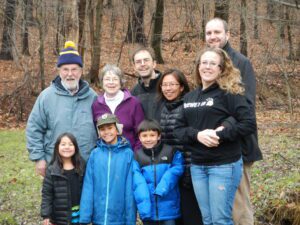
Board President
Ron McGarvey
Ron has been a member of Vermont Interfaith Power and Light since 2005. As a volunteer, Ron has provided free energy assessments for over 200 Vermont faith communities. These assessments identify opportunities for energy efficiency improvements and referrals to resources that can provide technical assistance and/or financial incentives. He has also been involved in the development and operation of the Katy Gerke Memorial Program which can provide matching grants for energy audits, efficiency and renewable energy projects.
Prior to joining VTIPL he was the Director of Residential Energy Services for Efficiency Vermont and prior to that Manager, Energy Conservation Service for MichCon, a natural gas distribution utility in Michigan.
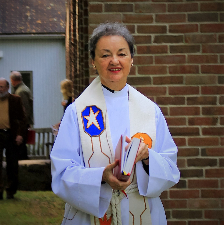
Board Vice-President
The Rev. Dr. Nancy Wright
The Rev. Dr. Nancy Wright is the Environmental Liaison for the New England Synod of the Evangelical Lutheran Church in America. She received the M.Div. degree from Union Theological Seminary and the Doctorate of Ministry degree in Leadership Studies from Boston University School of Theology. Pr. Nancy worked as a congregational coordinator at Earth Ministry, Seattle, and as a Program Associate at CODEL--Coordination in Development, which supported sustainable development projects around the world. Wright coauthored Ecological Healing; A Christian Vision (1993, with Fr. Donald Kill), "Christianity and Environmental Justice" (Crosscurrents, June 2011), and the chapter "Living Water" in Living Cosmology: Christian Responses to Journey of the Universe (2016). While serving as the pastor of Ascension Lutheran Church, S. Burlington, she co-authored the Congregational Watershed Discipleship Manual with fellow Board member Richard Butz.
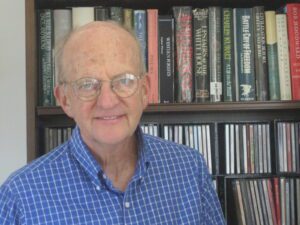
Treasurer
Sam Swanson
Sam, a founding Board member of VTIPL, has served as Board Vice President and President, and now serves as Board Treasurer. Sam has served on the South Burlington Energy Committee, the Vermont Clean Energy Development Board, and the governing board of Renewable Energy Vermont. He is a member of Ascension Lutheran Church in South Burlington where he has helped organize a sustained effort to contribute to the global campaign to address climate change. Over a twenty-year period, Ascension has reduced electricity use by more than 35 percent and cut natural gas use by more than 50 percent. Now retired, Sam spent the first half of his work-life addressing the environmental impacts of energy at the New York State Public Service Commission and the second half at not-for-profit public policy organizations, initially at Western Resource Advocates in Colorado and then at the Pace Energy and Climate Center at Pace University’s Elizabeth Haub School of Law.
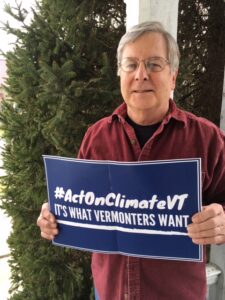
Board Member
Richard Butz
Richard retired to Vermont after 46 years of college teaching in areas including ceramics, design and engineering technology. He initiated a boat building program in Buffalo for urban youth and their families, coupled with water testing, to give them access to and perspective of local waters in which they fished and played. This led to a popular manual, Building the Six Hour Canoe. He has served as president of the board of Buffalo Niagara River Keeper, The Maine Crafts Council, and is on the Bristol Energy Committee, and the boards of The Addison County River Watch Collaborative, Vermont Interfaith Power and Light, and the Church Council of Ascension Lutheran Church in South Burlington. Along with Pr. Nancy Wright, he coauthored the Congregational Watershed Discipleship Manual sponsored by VTIPL. He also volunteers as teacher and worker at the Lake Champlain Maritime Museum.
Board Member
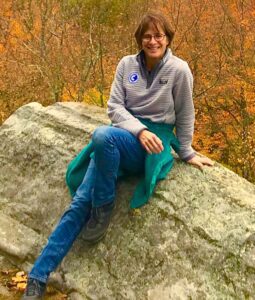
Prof. Rebecca Kneale Gould
Dr. Gould is a Professor of Religion and Affiliate in Environmental Studies at Middlebury College. She is a graduate of several training programs at Elat Chayyim Center for Jewish Spirituality. Rebecca is a member of the Addison County Havurah.
Board Member
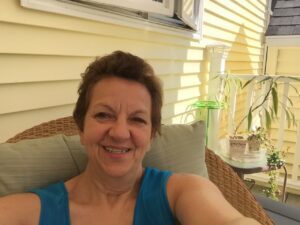
Rosanne Greco
Rosanne Greco has always had a deep spiritual connection with nature. Her passion to protect the natural world is integral to her spiritual beliefs. She has a BA in Psychology, a MS in Counseling and Guidance, and all course work completed for a PhD in International Relations. Rosanne served on active duty for 30 years. She was a intelligence officer specializing in strategic nuclear weapons and arms control, and retired as a full Colonel in 2003.
During her tenure on the South Burlington City Council, she enacted a pause on development in order to adopt plans to conserve the rural lands in the city. She also serves as President of the South Burlington Land Trust.
Rosanne is an active member of the First UU Society of Burlington (FUUSB), serving as chair of the Social Justice Committee and the chair of the Climate Justice Committee. She currently participates in Sunday services at both the FUUSB and at All Souls Interfaith Gathering in Shelburne.
Board Member, Webmaster
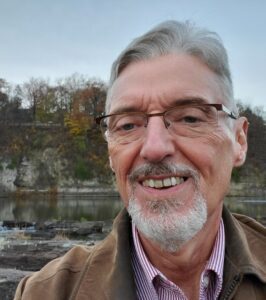
The Rev. Richard Hibbert
Dick Hibbert is a retired United Methodist pastor who last served the First United Methodist Church in Burlington. It was during that ministry that he joined the board fo VTIPL, serving at times as oits secretary and president. In retirement, he took up the responsibility of managing the organizations website, taking a break from active board membership. He has recently rejoined the board as a full member and is continuing to serve as its Webmaster.
Board Member
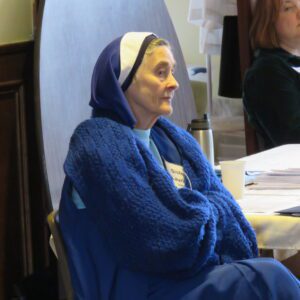
The Rev. Sister Laurian Seeber
Sister Laurian is an Episcopalian nun and retired priest. She began working for Creation more than a quarter century ago in work to prohibit aerial spraying of forests. In one way or another, she has been working for Creation ever since.
Board Member
Frank Guillot
Frank is a semi-retired architect. Over 50 years of practice, he has addressed a wide range of building types, especially churches, medical practice facilities and affordable and special needs housing. Response to the need for energy conservation and sustainability has been a central concern. Active in the Episcopal Diocese of Vermont, he oversees the operation of the Solar Orchard at Rock Point in Burlington and the ongoing energy conservation and CO2 reduction efforts there.
Executive Director
Chelsea Steinauer-Scudder
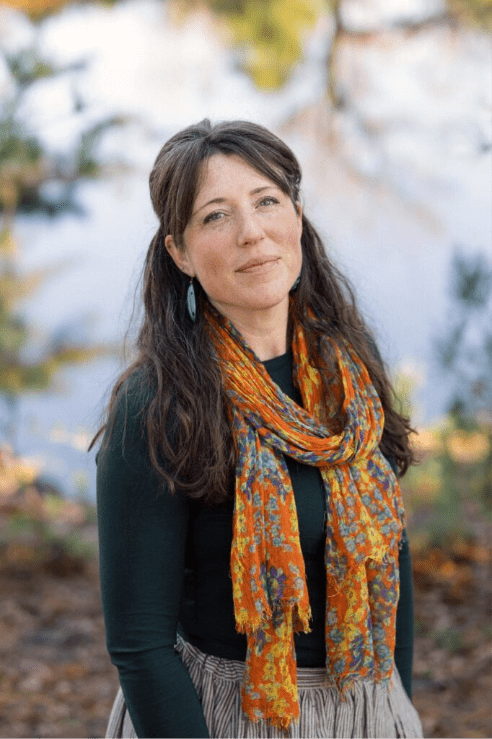
Chelsea Steinauer-Scudder is the author of MOTHER, CREATURE, KIN (Broadleaf Books, 2025) and has a background in nonprofit communications work. After receiving her masters of theological studies in comparative religion at Harvard Divinity School, her work and writing became focused on the confluence of relationship to place with experiences of the sacred. She served as Communications Coordinator for Kairos Earth in Canterbury, NH, from 2014-2016. From 2017-2022, she worked as a staff writer and editor for Emergence Magazine. Her writing has been featured in The Common, The Slowdown, Crannóg Magazine, EcoTheo Review, From the Ground Up, the edited poetry collection Writing the Land, and in Katie Holten's The Language of Trees: A Rewilding of Literature and Landscape.
History of VTIPL
Vermont Interfaith Power and Light (VTIPL) is a faith-based organization formed by about a dozen people from different faith communities who wanted to take action to address the climate crisis. They began meeting late in 2002 to begin laying the necessary groundwork for an Interfaith Power and Light organization in Vermont. The Environmental Ministry Team of the Episcopal Diocese of Vermont, with the support of Bishop Thomas Ely, provided the impetus to get this started.
In June 2004, VTIPL officially formed after the officers and Board of Directors were chosen. The Vermont Ecumenical Council (VEC) helped to launch VTIPL and it operated under VEC’s non-profit umbrella for four years. VTIPL was incorporated in the State of Vermont in September 2008.
The Interfaith Power and Light (IPL) movement began in the mid 1990’s. It was started by an Episcopal priest, The Rev. Canon Sally Bingham, and others, including Steve MacAusland, who went on to form Massachusetts Interfaith Power and Light, and helped VTIPL get started.
Forty states have IPL organizations, and each one is different because each state is different. What all the IPL organizations have in common is that they work with faith and spiritual communities to address global climate change. They are not "chapters" of the national organization. The state IPLs and national IPL are affiliated in a network that shares goals, resources and information.